Visit of the Society in Scotland for Propagating Christian Knowledge to Eriboll Mission.
In summer 1796, the Secretary, in pursuance of the plan which had been adopted, of his visiting in person the schools of the Society, set out upon a journey to Lord Reay’s country, where the Society have established a mission, besides a variety of schools.
As the report of that journey serves to convey some idea of that remote country, the Directors are persuaded that a short abstract of it will not be unacceptable.
This journey he found the most fatiguing and unpleasant of any he had made in the service of the Society. The weather proved to be uncommonly bad for that season of the year; for twelve weeks in succession, there was not one day, without rain, in that part of Sutherland; and that country, totally destitute of roads, and at all times boggy, except on its numerous rocks and hills, was then, in great measure, a marsh.
Having travelled by the way of Fort George and Tain, and crossed the two ferries at the head of the Firth of Dornoch, and experienced the hospitality of the worthy proprietor of Skibo, where deluges of rain detained him for some days, he travelled to Lairg, in the heights of Sutherland. There, in the house of the venerable Mr Mackay , minister of the parish, he was met, according to appointment, by Major Mackay, Tacksman of Eriboll, who not only undertook to be his guide, but brought him horses fit for travelling through the country, which his own were not, and were therefore left behind. Even with these horses, however well accustomed to the country, the progress through it was not a little difficult.
The course, (for roads there were none, not even a path marked out by footsteps,) lay either over rocks
amidst large loose stones, or over the tough surface of moss, in some places ten or twelve feet deep, or in the beds of rivulets, which had washed away the moss, and thus furnished a firm bottom.
In pursuing this course, the traveller, in order to keep somewhat in a straight line, is obliged to ride very much in water. A gentleman, who accompanied the Secretary [George Dempster of Dunichen], and who had been at pains to count, remarked that they had crossed one rivulet no less than four- and-twenty times in the space of an hour. But when they entered upon the wide and pathless morasses, Major Mackay, to whom the whole country is perfectly known, had the goodness to ride considerably ahead of the company, and carefully to explore the course which they could in safety pursue.
After twelve hours riding through such ways, and under an almost continued rain, late at night they reached the hospitable dwelling of their conductor, where every thing comfortable was furnished to them. Here were the Secretary’s head-quarters for several days; during which he was employed, when the weather would at all permit, in exploring the country round, examining schools, attending to stations where new schools were solicited, and in visiting the situation and accommodations of the missionary, lately appointed by the Society for the benefit of this part of the country.
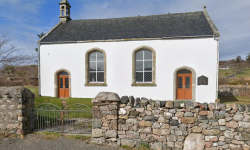
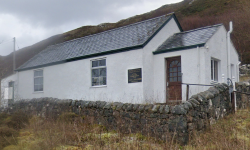
His charge is a most important and peculiarly difficult one. It consists of three different districts of as many parishes, viz. Durness, Edrachyllis, and Tongue, and contains about 1500 souls. His residence is at West-moine, or Eriboll on the side of the Loch, or arm of the sea, known by the name of Loch Eriboll, where he has a dwelling-house and offices, a croft of land, furnished by some neighbouring tacksmen, among whom Major Mackay bore the chief expense. There too is a chapel or place of worship, built and decently fitted up by the same persons, where the missionary officiates two Sabbaths, out of four, to a numerous congregation. The third Sabbath he goes to Edrachyllis, at the distance of about eighteen miles, which it is impossible to ride, owing partly to the extreme steepness of a hill which he must cross, and partly to bogs which lie in the way, and which will not bear the weight of a horse. The fourth Sabbath he officiates at Melness, the district assigned to him, in the parish of Tongue, and lying upon the west side of the arm of the sea, called Loch Tongue.
This loch, which separates the district of Melness from the parish church, the people cannot cross in stormy weather, nor have they at any time a number of boats sufficient to transport them.
To this part of his charge, the missionary has to travel over a continued bog of ten miles, called the Moine, where riding is most difficult, and, without an experienced guide, impracticable.
From the short detail here given, the importance, as well as difficulty of this mission may be estimated, and in no cafe have fifty pounds per annum of the Society’s money been better bestowed than in its endowment.
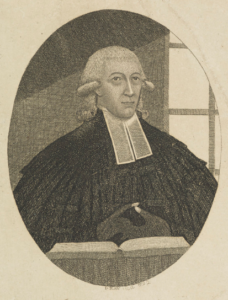
The charge is at the same time so very laborious to a conscientious minister, that a man only of a vigorous constitution, and in the prime of life, seems qualified to undertake it; and such in all respects was the Rev Mr John Robertson, who then filled it; a man, who, by the exertions of a vigorous mind, and by unremitting industry, had acquired both classical learning, and the Gaelic language, after he had attained to manhood.
He was born and bred in a country where no Gaelic is spoken; but having been, in early life, appointed one of the Society’s schoolmasters, in a Highland country, he was led to study that language, and in process of time acquired the utmost readiness and fluency in it.
The Directors think it proper to state here, Mr Robertson’s having since that time accepted of a call to be minister of a Chapel of Ease at Rothsay in Bute; the Directors, though they sincerely regretted, could not blame his removing to a far easier, and not less important charge.
Before appointing a successor, the Directors thought it necessary to have a more permanent security for the accommodations required, than the engagement of Tacksmen, whose leases they understood were soon to expire. On the first erection of this mission, they could obtain no security from the Proprietor of the estate; but as soon as the present Lord Reay, a promising young nobleman, succeeded, his man of business was applied to on the subject, and in course of a correspondence, his Lordship very frankly agreed to continue what was formerly enjoyed, and to furnish whatever more should be found requisite for the comfortable accommodation of the missionary.
The Directors nominated, in consequence, to that station, Mr Neil Macbride, a licentiate of the presbytery of Edinburgh, who had enjoyed one of the Society’s bursaries, and of whose piety and good principles, as well as general acceptableness, they were fully assured. To return to the Secretary’s journey:- Having finished his business in the immediate vicinity of Eriboll, having crossed the loch, and taken a view of that part of the parish of Durness, which lies towards Cape Wrath, he proceeded for Tongue.
His way led him across the Moine, the Bog formerly mentioned, and which was then greatly swelled by long continued rains. Even Major Mackay and Mr Robertson found a guide necessary to direct to a safe course. And although the guide had been born and bred upon the side of it, and kept a quarter of a mile ahead, shaking the ground with his feet, to ascertain where the way was practicable; they found the passage not a little difficult—one of the horses sunk down in the moss, and required the assistance of several men to extricate him.
Having visited the Society’s schools, in the parish of Tongue, assisted by the worthy Mr Mackenzie, the minister, the Secretary proceeded forwards, through the parish of Farr, (a district similar in all respects to Lord Reay’s country), to the parish of Reay in Caithness, where at length he had the satisfaction to find himself upon Terra firma; and where his kind conductor, Major Mackay, took his leave.
Of the country through which the Secretary had just passed, it is to be observed in general, that the arable land consists of patches by the sides of rivers, or arms of the sea, which stretch inland several miles. Some of the farms, particularly in the parish of Durness, have a considerable quantity of arable ground, and, for this country, are fertile in no common degree. The sea and the rivers furnish the inhabitants with fish in abundance. In the lands of Loch Tongue, cockles of an extraordinary size are found in the greatest plenty, and constitute no inconsiderable part of the food of the poor; the country, in general, consisting of hill and moss, is favourable for rearing black cattle, of which great numbers are annually sent to the English markets.
To a stranger, the aspect of the country must needs appear bleak and dreary, and it is poffible, as the
Secretary experienced, that his health may suffer from its extreme dampness; the natives, however, neither observe the one, nor are affected by the other. A more active, vigorous, spirited people are no where to be found, nor to strangers more hospitable and obliging.
In their general turn of mind they are sober and religious; their manners are orderly and decent; their thirst after knowledge is great; and, ever since the Revolution, their loyalty to the family on the throne, has, even in the worst of times, been unshaken. Among such people, it is not to be doubted that the Society’s Teachers are received with avidity and gratitude, and their schools well attended.
The Secretary was happy to find the schoolmasters in general, men of respectable talents, and attentive to their duty; nor did he find in any part of the Highlands, young people who discovered a quicker genius for learning.
Extracted from: An appendix report in: The Excellence of Christian Morality: A Sermon, Preached Before the Society in Scotland for Propagating Christian Knowledge, at Their Anniversary Meeting, Thursday, 6th June 1799. By the Rev. William Bennet.